20 top learning management systems for 2026
While many LMSes offer comparable features, HR leaders must consider the full product offering and cost. Here are some of the top LMSes on the market.

Learning management systems have long been popular tools for managing online education in corporations, nonprofit organizations, schools and government agencies. The typical LMS handles every major step of the process, from planning and creating educational content to delivering it to learners, tracking their progress, certifying completion and maintaining records. It serves as an administrative hub and central repository for e-learning and in-person courses.
LMSes earned a reputation as stodgy, often on-premises legacy systems that are hard to use, but LMS vendors have striven to shake that image with modern, web-friendly UIs; SaaS deployment; personalized learning paths; and generative AI that can make recommendations, write course descriptions, translate text, generate images and create entire courses.
Companies often incorporate an LMS into their HR system infrastructure to offer training to employees, which can be a cost-effective way for workers to build new skills and complete compliance courses. LMSes are geared to online instruction, though many LMSes also support in-person, instructor-led training and hybrid models.
While many LMSes offer comparable features, such as AI, HR leaders must consider the full product offering and cost when comparing one system to another. Some LMSes are part of a larger HR system, where the LMS is one module among many. Other LMSes are standalone and typically include more features.
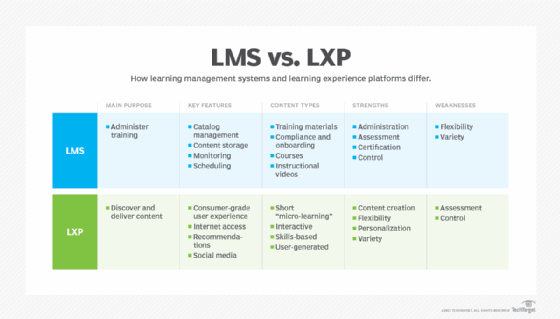
LMSes compete to some degree with a newer type of software, the learning experience platform (LXP), which emerged to make it easier to discover and deliver user-generated learning content, such as short microlearning videos and quizzes, and generally modernize and improve the LMS user experience (UX). But rather than replacing LMSes, LXPs are now viewed more as a complement, with many organizations keeping their LMS for administrative purposes.
Here are some of the top LMSes on the market as well as some key features that help differentiate each system. The following unranked list is based on information from Gartner, G2, Software Advice, web searches, the author's personal experience and vendor websites; it only includes products referred to by their vendors as LMSes and excludes LXPs.
1. Docebo
Docebo offers an AI-powered LMS, gamification, auto-assignment of training based on required employee skills and a catalog of skills and roles.
The company also provides access to more than 400 integrations through its marketplace, which simplifies single sign-on configuration and integration with HR information systems, conferencing systems and CRM software. The system also offers an AI virtual coach that employees can use to try out phrasing for a particular interaction and receive feedback.
2. TalentLMS
TalentLMS' implementation process is relatively quick, and the process for creating new courses is easy. The software includes a library of prebuilt courses and an AI tool that can help users develop new courses, which could speed up the transition from signed contract to employees using the system.
TalentLMS supports common course file types, such as Sharable Content Object Reference Model (SCORM), and supports more than 40 languages, so companies with a global workforce can configure the system to support each user's time zone and language. The LMS supports conference calls right in the system, with options for integration with third-party video conference systems.
3. LearnUpon
The LearnUpon LMS enables HR leaders to set up customized portals for each target audience, such as employees or partners. It also includes an authoring tool that makes course development easier and supports common course file types. LearnUpon is likely the best fit for companies looking for an easy-to-use system that doesn't require complex customizations.
LearnUpon works with several partners to simplify integration with third parties, including LXP vendor Degreed.
4. Moodle
Moodle is a free, open source system that companies can download and install. That means they can customize it to meet their specific needs, and a community of developers works to improve the system. Companies that require help installing, configuring and maintaining the system can hire Moodle specialists directly through the vendor or through Moodle's certified partner network. Moodle currently supports over 100 languages.
Moodle also offers MoodleCloud, which is aimed at small companies that don't need customizations and are looking to get the system up and running quickly.
5. GyrusAim LMS
Like many LMSes on the market, GyrusAim LMS supports both instructor-led and e-learning courses. It also supports numerous online conferencing applications, so instructors can offer live webinars. Instructors can register users through GyrusAim LMS, as is the case with many other LMSes.
GyrusAim LMS can track user skills and competencies for gap analysis and recommend courses for users through its AI. It also provides features aimed at companies operating in regulated industries.
6. Cornerstone LMS
Cornerstone LMS can be licensed individually or as part of a larger HCM system. The system is very configurable, and both internal and external users can use it.
The application includes an integrated course development tool, and users can create a course externally, then upload it into Cornerstone LMS. Permission settings are extensive and enable system administrators to develop roles for specific types of users. The application also includes an option to charge course participants.
7. Canvas
This platform is designed to support learning at all levels, from K-12 students to higher education and, finally, to corporate learners. It provides features for employee training in blended learning environments or more focused in-person or remote settings. In 2024, Canvas was updated with a slew of AI and collaborative learning features.
Trainers and employees can collaborate during a live session using the Canvas Studio tool, which enables students to upload videos and add comments. Trainers can also upload content for further reading by course participants.
8. Blackboard
Blackboard has been in business for more than 20 years, and its platform is the de facto standard in higher education for course management, giving the vendor the opportunity to expand its product offering.
Blackboard includes an LMS and additional modules designed to enhance the learners' and training team's experience. The LMS can be accessed on any device with a responsive interface, providing users with a mobile learning experience that matches that on a desktop computer. The vendor is focused on providing an accessible learning environment for all learners, including features that conform to global accessibility standards. They include Blackboard Ally, a tool that checks content for accessibility and can translate content into over 100 languages. Blackboard also offers consulting services to help customers develop accessible training content.
Like many products here, Blackboard made significant AI additions in 2024, including a generative AI "persona" that can carry on conversations with students on specific educational topics and doubles as a tool for building AI literacy.
9. Brightspace
Brightspace bills itself as a learning innovation platform, moving beyond what a traditional LMS offers by including additional functionality and an improved UX. The system can be used by people in any organizational setting or stage of life, including K-12, higher education, corporations and nonprofits.
The Brightspace system includes gamification features, functions that support accessibility and a responsive website that supports any device, according to the vendor. Learners can download lessons to complete offline and create profiles that show what they are working on and their interests. Brightspace has an AI feature that provides feedback to learners on how they speak and use key terms. The company introduced in 2024 an AI-based accessibility checker and a text-to-speech reader.
10. iSpring LMS
The iSpring LMS platform is available both as SaaS and on-premises. Courses can be developed in a variety of ways and contain different types of content. For example, the system supports traditional SCORM files -- the LMS standard for e-learning content -- as well as role-play simulations, interactive courses and training videos. It is designed to enable course creation by learning professionals and subject matter experts with user-friendly tools that speed up and simplify course development, including such software as Microsoft PowerPoint. New functionality includes an AI-powered image generator and an AI-powered translator.
In addition to the LMS functionality, companies can use iSpring LMS to host a corporate news feed, that includes company-wide announcements, user comments and reactions in the form of emojis, and employee profiles, according to iSpring's website.
11. Absorb LMS
Absorb LMS offers users many standard LMS features plus the ability to add other modules to build a comprehensive learning environment. It comes preconfigured to enable third-party courses from different vendors, which enables companies to pick and choose the courses that best meet their needs and start engaging employees quickly. The application can also be used to train customers and partners.
Companies can integrate other offerings from Absorb. For example, Infuse provides features for integrating course content directly in the systems employees already use, such as a CRM or ERP. That capability enables microlearning, in which courses are short and can be taken on the spur of the moment. Absorb Engage adds a social aspect to the learning environment, including leaderboards, the ability to add news articles and the option to add public social media.
12. Cypher
Cypher is an LMS for training K-12, students in higher education and employees. The vendor uses AI to drive many of the product's features, such as accelerated course development and the ability to assign courses to employees automatically. There are also features designed to enhance community involvement and help employees find internal coaches and mentors, as well as peers who are interested in the same topics.
Organizations can also use Cypher to train external workers, and each learning program can have its own portal and security.
13. LearnWorlds
The LearnWorlds LMS supports both internal employee training and external training for partners and customers. Companies can also use it to sell courses. The LearnWorlds website touts the platform's simplicity for trainers and learners alike. New AI features enable content developers to extract content from existing video courses and use AI to build new courses.
An organization's learning team can use the platform's form and survey designer to gather feedback from the people who take the courses to identify areas for improvement. LearnWorlds also provides tools for building a customized mobile app, with supposedly no coding required, which enables system administrators to design the app in a way that matches the organization's brand.
14. Acorn PLMS
Organizations can use the Acorn Performance Learning Management System (PLMS) for employees, customers and partners, and third parties can use it to monetize course delivery. The portal for each group can be customized to meet its specific needs. Acorn PLMS includes built-in performance management features, which enable organizations to directly connect their performance management process with the training available in the LMS.
With Acorn's social features, employees can collaborate to share their knowledge and experience, so it can be captured and reused by others. The system is also designed to record employee development plans and enable managers to track employee progress against the goals.
15. Eloomi
Eloomi is marketed as a combined LMS and LXP. The platform offers performance management features, including the ability to record one-on-one meetings, create goals and connect employee skill development requirements with courses available in the LMS.
Users can build courses in Eloomi, import them from other systems or choose prebuilt ones from Eloomi's content store. Users can also add courses to learning paths that can support blended learning approaches.
HCM software vendor Dayforce, formerly known as Ceridian, acquired Eloomi in 2024.
16. eFront
The eFront LMS enables customers to access the software code to customize the platform, which runs in the cloud or on-premises. In addition to enabling code changes, the LMS includes numerous configuration features available out of the box and the ability to extend the platform using custom plugins.
Organizations can offer training content on its own or as part of a learning path that can include quizzes and tests. Courses can be assigned according to predetermined criteria, such as skills attained or prerequisites completed. Customers can use eFront to sell courses to external parties.
17. ProProfs
The ProProfs LMS comes with 100-plus professionally built courses that companies can brand and edit to meet their needs. According to the vendor's website, ProProfs online courses can include handouts, flashcards and end-of-chapter assessment quizzes in addition to many other features. The AI functionality can also help users develop new courses. While editing courses, users can add other kinds of learning content, such as videos, graphics and presentations.
The system includes shared folders with access control to help simplify file sharing among members of the training team. Organizations can also use the system as a knowledge base and training material storage receptacle.
In November 2024, the vendor announced its acquisition of PeopleGoal, a maker of performance management software. The two systems continue to operate separately.
18. SkyPrep LMS
SkyPrep LMS comes in 21 languages to support companies with an international footprint. The LMS offers gamification tools to encourage learning, including points, badges and a leaderboard. It automates routine tasks, such as course assignments, based on configured rules, reminders and scheduled reports. The tool updates employee profiles using course completion ratings.
The vendor also offers SkyPrep Studio for creating multi-lingual and interactive learning content with minimal effort, according to the website. The authoring tool has a drag-and-drop UI and lets users save courses to SkyPrep LMS or export them as SCORM files.
19. LearnRight
LearnRight is a newer LMS on the market. The vendor offers many of the features commonly found in an LMS, including AI capabilities for generating course content, community creation tools and gamification. Also, content developers can store files such as images and videos on the platform.
Unlike many other vendors, LearnRight permits customers to pause their contract for up to 12 months and only charges them for active users. They also offer multiple software tiers so customers can find the price point and functionality that best fits them, and customers can change tiers in the future if desired.
20. Adobe Learning Manager
Adobe Learning Manager is an LMS that includes an optional LXP. Courses can be made available in other enterprise applications, such as Salesforce, using APIs so employees can complete courses in the systems they already use. The completion data is maintained in the LMS regardless of how employees access the course.
AI can recommend courses, identify suitable courses for employees' needs and help users develop new courses. The vendor also offers more than 86,000 courses and learning journeys.
Eric St-Jean is an independent consultant with a particular focus on HR technology, project management and Microsoft Excel training and automation. He writes about numerous business and technology areas.